
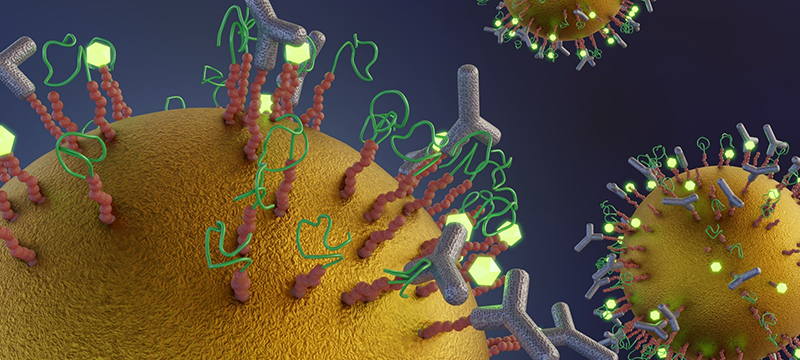
Our previous newsletters focused on genetic tests based on real-time PCR (read it here) and dPCR (read it here) that can detect and identify a single molecule. In this edition, we will investigate recent progress toward femtomolar sensitivity immunoassays for early disease detection in conversation with our application specialist, Dr. Alexandre Larmagnac.
What are the challenges in detecting and identifying single molecules using immunoassay-based techniques? Why do we hear that a COVID-19 antigen test is less sensitive than a PCR test?
Genetic tests benefit from the high specificity of molecular tools like PCR and sequencing that nature has developed through millions of years of evolution. The specificity originates from the nucleotides sequence used: there are a trillion possible combinations for a sequence of (only) 20 nucleotides; this is why primers with about 20 base pairs are usually used in PCR to amplify nucleic acid sequences with high specificity. After target amplification by more than a billion-fold, the signal becomes distinct from the background noise, indicating the original presence of a single molecule.
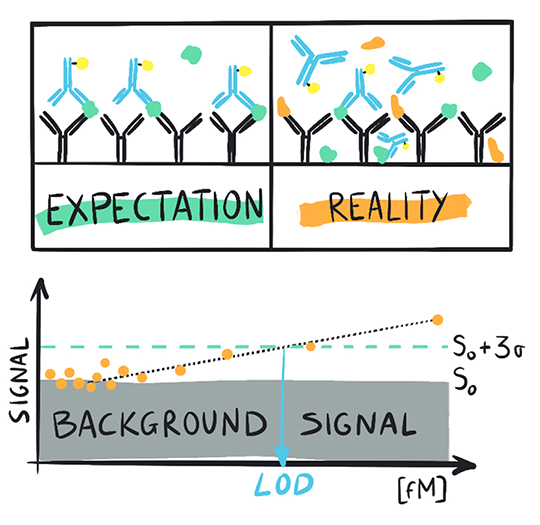
Immunoassays (IAs) rely on the Specific Binding (SB) affinity between an antibody and its epitope. To detect diagnostically relevant biomarkers that are present in the blood, antibodies are selected for their high affinity to the epitope of the targeted biomarker and low affinity to all other molecules present in the sample. There are over 10 billion albumin molecules in the blood for every cardiac marker, like troponin I. Despite its low affinity to albumin, if even thousands of albumin molecules bind to the antibodies, it will create a high background signal that will mask the presence of single troponin molecules. This Nonspecific Binding (NSB) plays a key role in determining the detection limit and is often the bottleneck toward higher sensitivity. Additionally, the background signal arising from contaminants, e.g., defects in the consumable and detector, will further limit the sensitivity. One famous example is the lateral flow assay, where the scattering nature of the nitrocellulose substrate is the main contributor to the background signal. That is why COVID-19 rapid tests have a Limit of Detection (LOD) in the order of 10,000 viruses.
I recommend reading a comprehensive article* on NSB and strategies to minimize its impact on immunoassay sensitivity by my former research colleague at ETH Zürich, Dr. Andreas Frutiger. This is a great read on the topic!
*https://pubs.acs.org/doi/10.1021/acs.chemrev.1c00044
What are the advantages and challenges of digital immunoassays?
State-of-the-art instrumentation like luminometers found in high-throughput IA lab analyzers measure light emitted from the bulk. If you could partition your sample and interrogate each partition as in dPCR, you would quantify more precisely the binding events and improve the sensitivity. The challenge is then to reliably detect the very weak signal coming from a single binding event in a partition.
A popular solution is Digital ELISA, which can count single molecules and enables clinically relevant proteins to be measured at femtomolar concentrations.
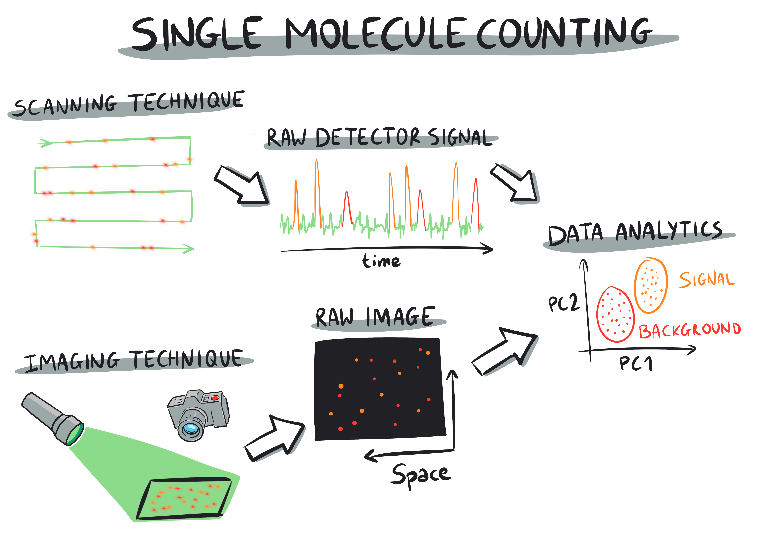
Digital IA solutions use scanning or imaging methods to produce data where binding events are separated in time, space or both. Usually, a large amount of data is generated and requires complex readout algorithms to separate binding events from dirt, scratches or noise of the detector and SB from NSB. Hopefully, that is a technical problem that can be solved. Challenges such as short time to result and low instrument cost must be addressed for successful product commercialization. That is even more true with product features like multiplexed assay.
What solutions does Volpi provide to accelerate the development of such novel platforms?
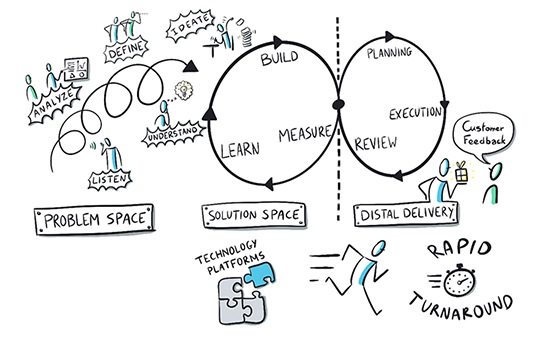
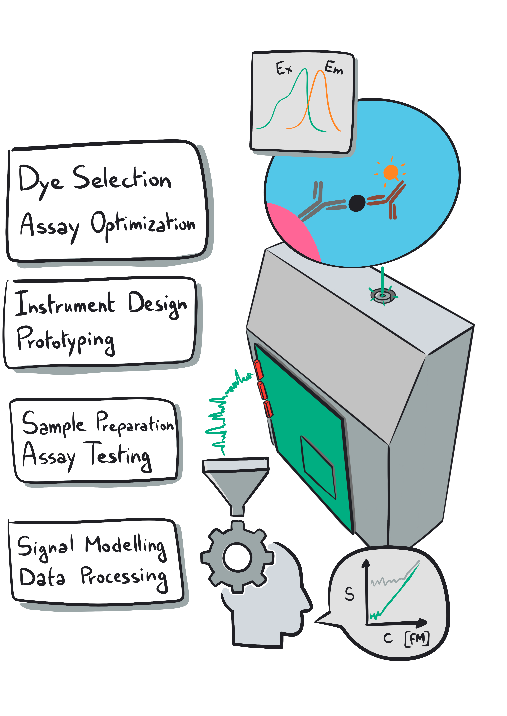
Because of the complexity of the measurement chain, supplying an optical module that can detect a single binding event is necessary but not always sufficient to provide the solution our customers are looking for. As experts in optics-based measuring systems for the IVD and Life Science industries, we enable our customers to use our optoelectronic measurement system efficiently and generate the high-quality data they need.
Volpi is very versed in performing design thinking or requirements engineering workshops and rapid proof of concept with IVD and Life Science customers who can “just” tell us about their application needs, the type of assay and the targeted performance. In return, they get a bespoke plug-and-play solution, including data analytics that they can seamlessly integrate into their workflow. To accelerate the development of the solution and reduce risks, we leverage our Technology Platforms whenever possible.
For a large IVD company, we designed a bespoke, laser-based, single-molecule counting solution. We used a model-based approach combined with experimental data to identify and dimension the critical system parameters. Our engineers designed and built the whole system, including an automated testing fixture. In our wet lab, our scientists prepared samples, ran measurements, analyzed data to ensure we had the right solution and provided feedback for optimization. Using advanced data analytics, our solution can more reliably separate the “good” signal from the background noise, enabling single-digit femtomolar sensitivity. Because we will manufacture modules in the future, we ensure the design is optimized for performance at cost.
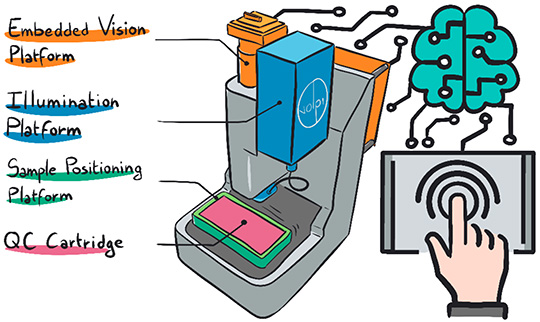
We pre-developed compact and cost-effective automated digital microscopes and data analytics platforms to address unmet market needs for POC digital IA platforms based on nanoparticle imaging. In such digital IAs, strong scatterers like gold nanoparticles are used to detect binding events. The signal from these particles must be sufficiently uniform and different from the other particles or dirt that can scatter light for reliable and highly sensitive measurements. We select the adequate nanoparticle for our customers’ assay requirements and adapt our system parameters accordingly to provide optimal analytical performance. For that, we prepare samples in microfluidic cartridges and perform assay testing. We provide our plug-and-play, sample-to-data solution with a user-friendly interface to boost productivity on the customer side. With a turnaround time as short as 1 month, this is a true game-changer for our customers.

Dr. Alexandre Larmagnac
Head of Applications & Sales Support