

With the advent of rapid “syndromic” multiplex PCR testing, patients benefit from swifter results and shorter hospital stays, minimizing the risk of nosocomial infections and saving thousands in healthcare costs. What’s behind this breakthrough, and how can we navigate its challenges?
The emergence of “syndromic” multiplex PCR testing has expedited respiratory virus diagnostics, saving time and cutting healthcare costs. However, this advanced technology comes with its own hurdles, which we will discuss in depth.
Rapid sample-to-answer “syndromic” multiplex PCR testing for respiratory viruses can reduce the time to results and length of stay in the hospital for patients by approximately one day compared with routine lab-based PCR testing. This could reduce the risk of acquiring nosocomial infection, improve patient satisfaction and reduce the cost of healthcare by approximately $3,000 per day.
So, what are the typical challenges with multiplex PCR? And what is critical for bringing it to the Point-Of-Care (POC) instruments?
Multiplex PCR is a generation of PCR in which two or more genes (target DNA sequence) are amplified in the same reaction simultaneously. A pair of primers is required to amplify each target gene.
The higher the multiplexing, the more the primers and the higher the likelihood of receiving erroneous amplification results due to primer dimer formation. Low concentrations of the target gene are not efficiently amplified due to the lack of amplification resources such as dNTDs, primers and polymerase. This effect increases the Cq value and can lead to false negative results, decreasing the assay’s sensitivity. Inefficient light detection, non-optimal consumable design or thermal cycle profile can also yield false negative results.
Detection of primer dimer amplification can lead to false positive results and decrease assay specificity. Such false positive results can be prevented using, for example, target-specific TaqMan probes. Such probes contain a fluorophore that emits light at a specific wavelength. The specificity of the light detection is key to ensuring high assay specificity. In multiplex assays, where multiple fluorophores are present in the reaction, the bright signal from a first amplified target detected by a first detector may cross over to a second detector and falsely signal the amplification of a second target. This effect, known as spectral crosstalk, can lead to false positive results and decrease the assay specificity.
The molecular diagnostics solution providers have developed various platform solutions for running multiplex assays. Consumables can range from a single tube to 96 well plates and, more recently, a microfluidic cartridge containing one or more reaction chambers. For PCR, amplification is usually done by thermally cycling the reaction sample. Alternatively, the reaction sample can be rapidly moved between hot and cold regions, enabling faster cycling and a significantly shorter time to results. Scanning fluorescence readers offer excellent cost-to-performance solutions when working with well plates but are slower than non-scanning solutions.
There is no universal solution for this market’s different needs. In core lab settings where throughput is important, the thermocycler and fluorescence reader are usually dimensioned to operate with a medium to large number of reaction vessels. Conversely, in POC settings where only one patient sample is usually processed at a time, the fluorescence reader is dimensioned to operate with a few reaction vessels.
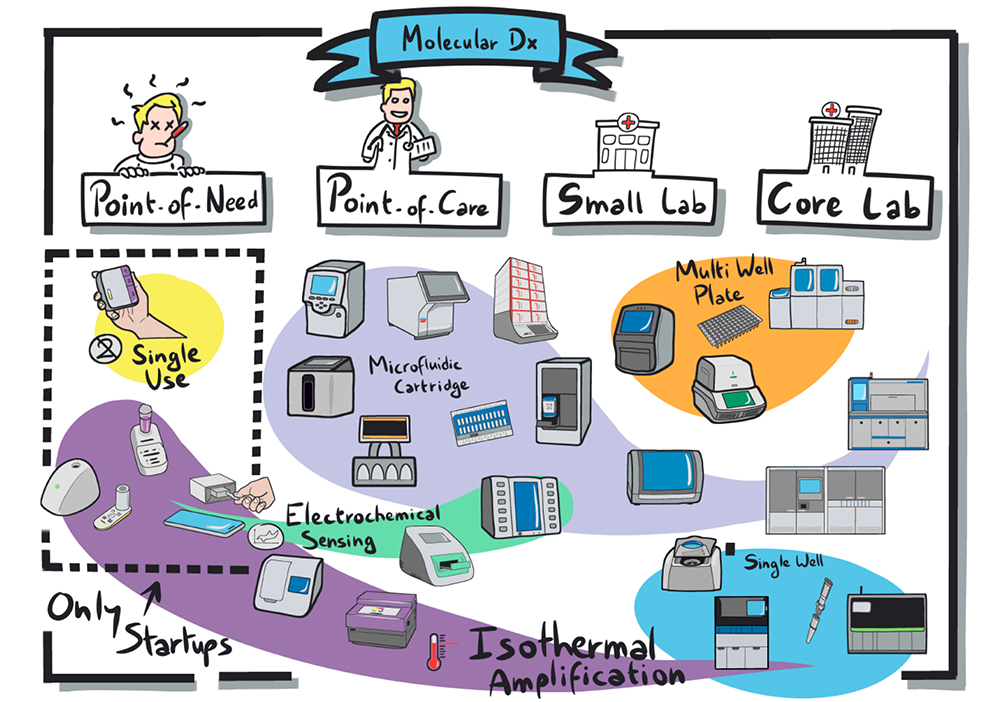
Quantitative multiplex PCR done in the lab on traditional 96 well plates often requires high Cq uniformity among wells. One of our customer’s key performance requirements recently was a Cq uniformity of 0.1 over all 96 wells. By carefully selecting the architecture and specifying the performances of the sub-systems like thermocycler (temperature precision and homogeneity) and fluorescence scanning head (spatial and spectral crosstalk), such a high Cq uniformity was met at a very competitive cost.
For POC settings, non-scanning readers and a spatial thermocycler are typically the best solutions for performance, reliability, size and cost.
Volpi’s leading solution
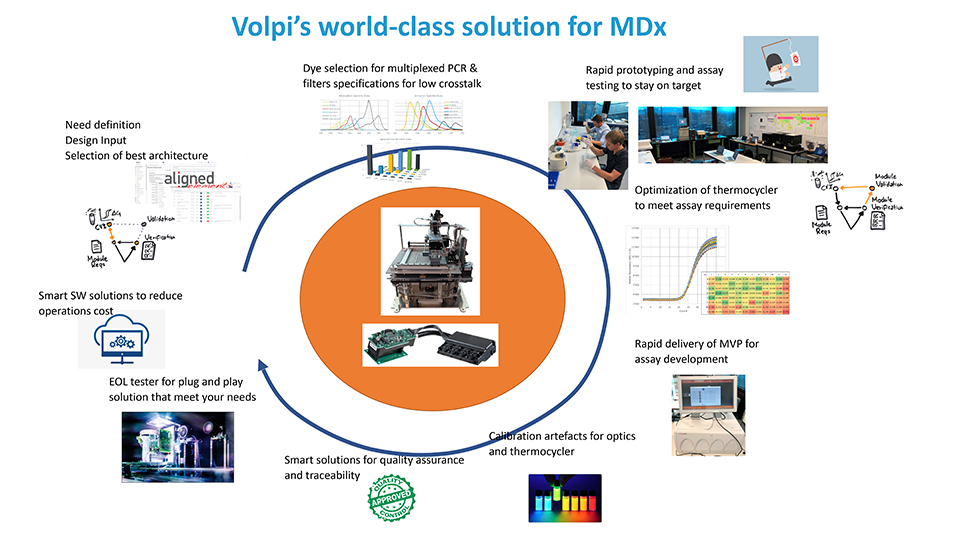
Over the past 10 years, Volpi has developed a world-class experience in instrumentation for multiplex PCR and several Technology Platforms matching the needs of the different market segments. Our offering includes a set of products and services that accelerate time to market and reduce development risk.
Our Technology Platforms realize functions like light generation, light shaping and transport, light detection, thermal cycling and much more. They are modular and can be integrated into a solution meeting customer needs.
Volpi’s products and services include complete thermocyclers with multi-channel fluorometers, stable fluorescence calibration tools, spectral characterization of dyes, rapid delivery of minimal viable products to your assay team and dye selection for low spectral crosstalk.
Please read here about how Mobidiag benefited from our Technology Platforms and expertise for their POC platform.
Please read here about our 16-plex solution for the Quidel Savanna POC platform.

Alexandre Larmagnac, Ph.D.
Head of Applications and Support